

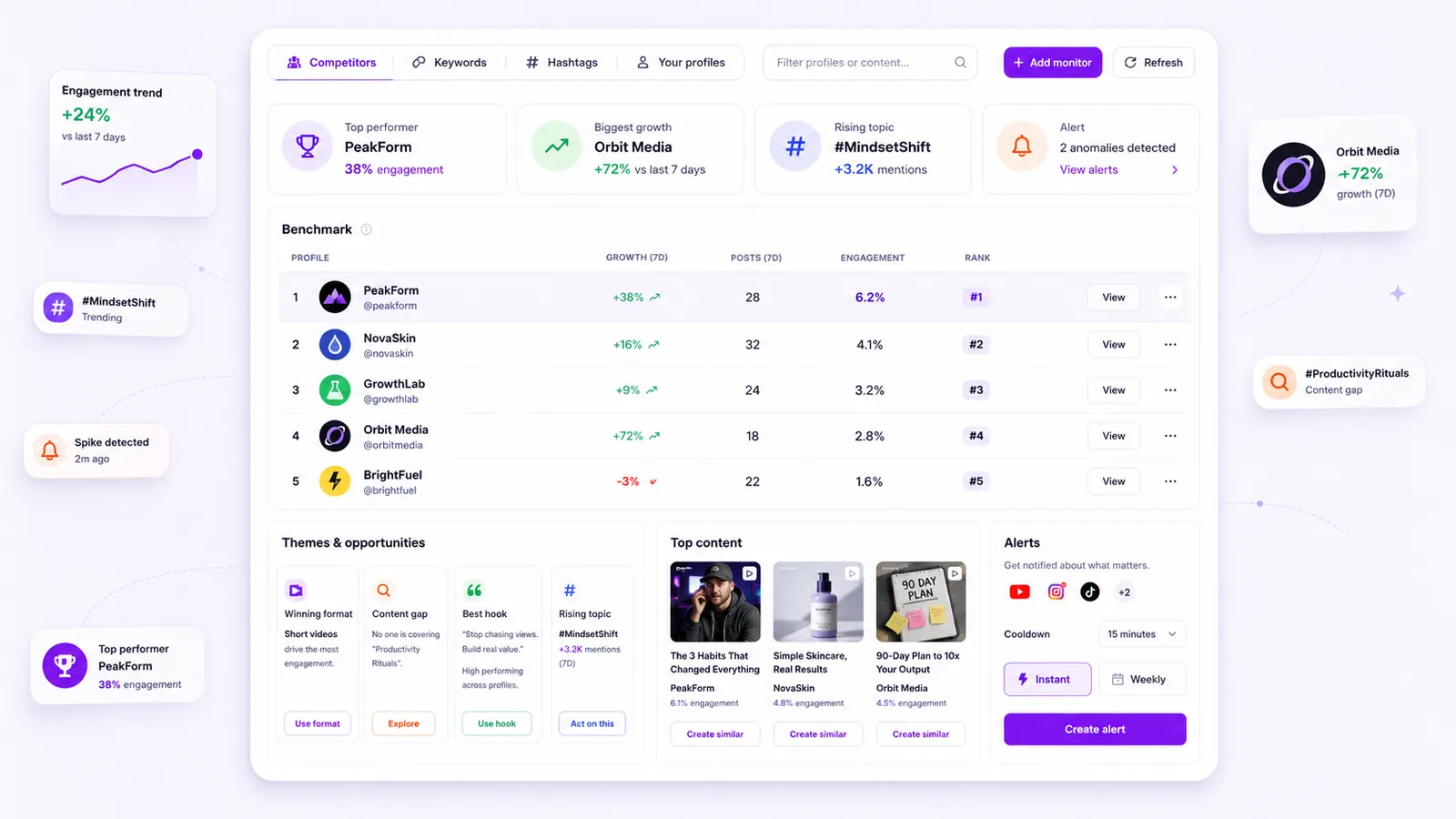
If your Intelligence Dashboard shows the same performance rankings for three weeks running, stop staring at the refresh button. Your benchmarks are not broken-they have simply lost their relevance to how your competitors are actually moving.
We know the feeling: you are ready to present a quarterly update, but the numbers feel frozen in time. The pressure to stay ahead is constant, and when your tools seem to drag their feet, it is easy to panic. We have all been there-social media operations are messy, and technical glitches are the last headache you need.
The awkward truth is that most stale data is caused by human-led setup decay, not system outages. You are likely monitoring the wrong signals for the current market cycle. The 90-Day Drift Rule applies here: if your benchmark list has not been audited in three months, you are almost certainly measuring a market that no longer exists.
The decision each metric should trigger

Most teams treat competitive intelligence like a passive ticker tape, but the data is only as good as the decisions it forces. If a metric does not compel you to add, prune, or pivot, it is just digital noise.
Think of your dashboard as a living portfolio rather than a static report. Every row in your benchmark table should correspond to a strategic question you are actively trying to answer.
| Metric Cluster | Strategic Decision Trigger |
|---|---|
| Growth Rank | Does this competitor's current growth require us to adjust our ad spend or messaging frequency? |
| Content Themes | Are these topics signals for us to double down, or are we just chasing a dying trend? |
| Top Posts | Does the high engagement on these specific formats suggest we should overhaul our upcoming creative calendar? |
| Opportunities | Have these gaps identified a content white space that we can feasibly capture in the next 30 days? |
Operator rule: A benchmark you are not prepared to act on is a distraction you cannot afford. If a competitor has pivoted their brand identity or drifted into a niche irrelevant to your current focus, remove them immediately.
At Mydrop, we often see teams get stuck in "analysis paralysis" because they are tracking too many profiles. When your monitoring scope gets too wide, your signal-to-noise ratio drops. We usually advise users to refresh their Inspiration Suggestions to replace inactive or misaligned leader profiles with brands that are currently hitting high-velocity engagement.
If you are not using your monitoring tool to identify where you need to shift resources, you are effectively flying blind while watching a ghost. The goal is to move from passive reporting to active signal detection. If the data is stale, the problem is almost always that you are still measuring yesterday's competitors.
The scorecard that keeps reporting useful

The best way to stop the "frozen dashboard" panic is to treat your monitored profiles like a dynamic portfolio, not a static list. If you are tracking every competitor just because they exist, you are essentially burying your team under noise.
A healthy Intelligence Dashboard should be a filter, not a firehose. At Mydrop, we often see teams get trapped because they keep adding profiles but never prune the ones that no longer align with their current content themes or target markets. To keep your benchmarks actionable, we recommend running a simple quarterly scorecard for every account in your monitoring queue.
| Metric | Threshold for Keeping | Action if Below |
|---|---|---|
| Content Alignment | Shares at least 2 key themes with your current strategy. | Move to "Inspiration" list (archive from benchmark). |
| Growth Velocity | Shows consistent 90-day activity (not dormant). | Pause tracking until next major campaign. |
| Engagement Quality | Visible community interaction (comments, saves). | Move to "Watch" list (remove from core leaderboard). |
| Brand Priority | Direct competitor in your primary market. | Keep in primary benchmark view. |
The trick is to be ruthless. If a profile doesn't pass the "Content Alignment" check, it is stealing your attention and diluting the quality of your competitive insights. By moving stagnant competitors out of your primary benchmark rows, you instantly clarify the competitive landscape that matters for your next executive update.
Decision check: If a monitored competitor has not updated their primary content format in 90 days, stop including them in your core growth metrics. They are no longer a benchmark; they are a legacy archive.
What to stop measuring by default
When data starts feeling stale, the most common fix is actually to stop measuring things that no longer provide a "decision signal." We see many teams tracking generic industry leaders simply because they are famous, but if their post-to-post strategy doesn't impact your brand's performance, that data is just vanity.
Stop tracking these categories by default:
- The "Legacy" Leader: Brands that were relevant two years ago but have shifted to a holding pattern or different niche.
- Broad-Interest Hashtags: If you are monitoring hashtags that yield thousands of posts a day but none that convert, you are just looking at a ghost town.
- Dormant Global Accounts: If your focus is regional, stop letting global accounts with different market-specific strategies mess up your local ranking data.
Instead, shift your focus to high-velocity niches where your target audience is actually spending their attention. In our experience, teams find much better success when they use AI to suggest active, niche-relevant profiles instead of manually curating lists that eventually go stale. When you refresh your inspiration suggestions, you get a fresh view of who is actually winning in the current market cycle, rather than who won last year.
At the end of the day, your benchmarks should reflect the market you are competing in today, not the market you entered when you first set up your account. Clearing out the noise is not just about tidying up a dashboard; it is about ensuring the data you report actually helps you decide what to do next.
How to connect metrics to next actions
A dashboard full of numbers is just decoration until you attach a so-what to every row. If you look at a growth rate and feel nothing, your measurement model is purely performative.
We find the best teams don't track metrics to track performance; they track them to trigger specific operational pivots. When your intelligence data shows a shift, it should immediately point to a specific team or workflow.
Workflow check: Every benchmark shift must map to a specific "response trigger" or it gets removed from the view.
Try using this simple decision matrix to turn passive observation into active work:
| Observation | Immediate Signal | Next Action |
|---|---|---|
| Competitor post surge | High engagement variance | Task team to identify hook |
| Topic cluster stall | Declining audience interest | Prune/Rotate keyword set |
| New leader rising | Content format shift | Update inspiration sources |
| Zero growth trend | Channel signal decay | Audit connection credentials |
At Mydrop, we often see teams get trapped in the "analysis paralysis" phase because they are looking at too many metrics at once. If you are managing twenty brand profiles, stop looking for universal truths across all of them. Filter your view to the single market or content theme that matters for this week and ignore the rest.
The review cadence that makes the model stick
Operational drift happens when intelligence reviews are treated as a "when we have time" task. If you leave your dashboard for a month, you are not monitoring the market; you are catching up on history.
For enterprise teams, we recommend a tiered cadence that prevents the "oh no, our data is old" panic before a stakeholder meeting:
- Weekly 15-Minute Sync: Rapid-fire check of your top-tier competitor alerts and format changes. This is when you perform manual targeted refreshes to ensure your data is pulling the latest signals.
- Monthly Strategy Pivot: A deeper look at content themes and opportunity clusters. This is the moment to prune ghost-town keywords and add fresh industry leaders suggested by your intelligence tools.
- Quarterly "Grounding" Audit: A complete review of your monitored profile list. Ask: Are these still the competitors we care about? If not, delete them. A cleaner list is always better than a long one.
Most teams don't have a data problem; they have a maintenance problem. If your team is too busy to perform this audit, you are likely suffering from coordination debt-you have too many channels to manage and not enough clarity on which ones actually move the needle.
Conclusion
Stale benchmarks are usually the canary in the coal mine for a larger operational issue. If your data feels frozen, it is telling you that your focus has drifted from where the market is actually playing.
Don't spend your time fighting the platform or waiting for the system to catch up on its own. Reclaim your visibility by forcing your tools to align with your current strategy. Audit your list, refine your keywords, and keep your monitoring scope as lean as your actual content output.
Social media work is inherently messy, but your intelligence shouldn't be. Keep your benchmarks sharp, your list relevant, and stop treating the dashboard like a permanent record-it is a live map of the current battlefield. Go prune the list, refresh the signals, and get back to the work that actually impacts the brand.
 Google review
 Trustpilot review
 Product Hunt comment